
A Turnkey Service
Causal Intelligence from Eyeris is a managed data service that runs continuously within the data flow of your business. Our service captures every activity across your systems, translates it all into a common business language, connects each event to its causes and effects, and exposes that causal intelligence to executives, analysts, systems, and Stella — our ultra-secure, client-dedicated analytical AI for the C-Suite.
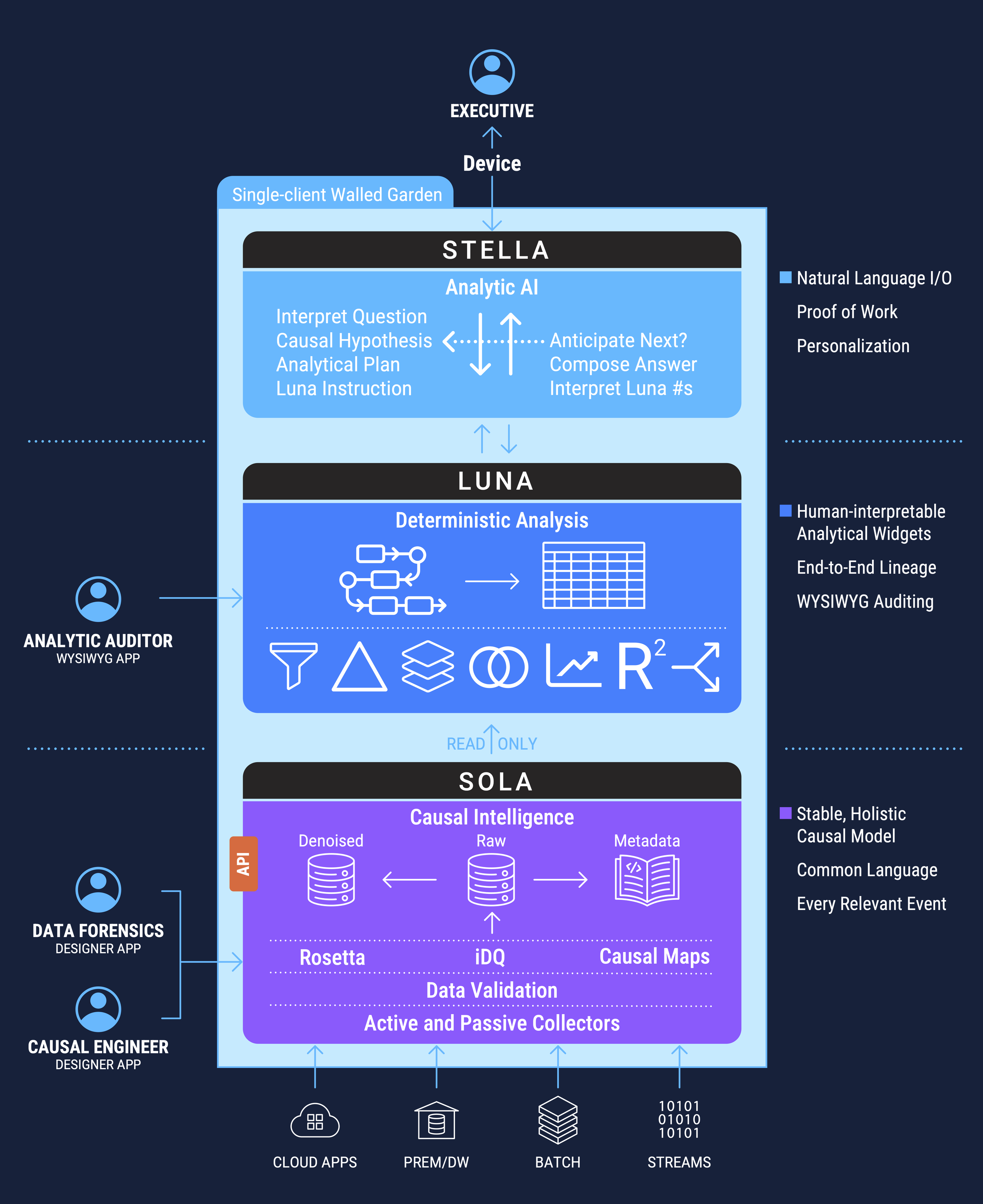
Data Collection captures and validates every event. Active collection pulls data from source systems. Passive collection receives event streams pushed from client systems. Data validation enforces a strict data interface contract, ensuring that structure and content are consistent before further processing.
Causal Mapping and Measurement transforms events into a unified and reliable system of relationships. A semantic Rosetta translates all inputs into a common business language. Intelligent Data Quality reconciles overlapping observations of the same event across systems and aligns timing differences between them. Causal maps then define the cause-and-effect relationships between events, including constraints and measurable causal force.
Causal Intelligence operationalizes those relationships as an accessible database. Raw causal surveillance captures each cause-effect link activation as it actually occurrs, which provides transparent auditability. Statistical denoising adjusts for outlier events, producing a stable view of causality for decisions.
Sola: A Causal Data Foundation for Analytic AI
Luna: Computational Reliability and Human Interpretability
Deterministic Analytic Widgets are the sole quantitative basis of every analysis, ensuring that the derivation of every number is verifiable, consistently reproducible, and human interpretable. This eliminates the central weakness of LLMs in analytical work: unstable calculation results.
Lineage exposes exactly where a number came from and exactly how it was handled between source and report. This provides a rich description of each datum’s meaning, based upon provenance and manipulation.
WYSIWYG Auditing builds system trust by providing a step-by-step transparent pipeline for human auditors in a code-free visual interface.
Stella: AI for the C-Suite
Causal AI is designed from the start to focus on actions and outcomes, on root causes and what-ifs. Using the rich causal signals emitted by Sola, Stella goes beyond merely fetching data: it reasons fluently across the complex cross-functional linkages of a modern enterprise, bringing sophisticated bespoke reports directly to the point of executive curiosity. It’s far more than a cool version of search. It’s a brilliant personal digital analyst in your pocket 24/7.