
Why is Causal AI different?
The Quick Answer
Technically…
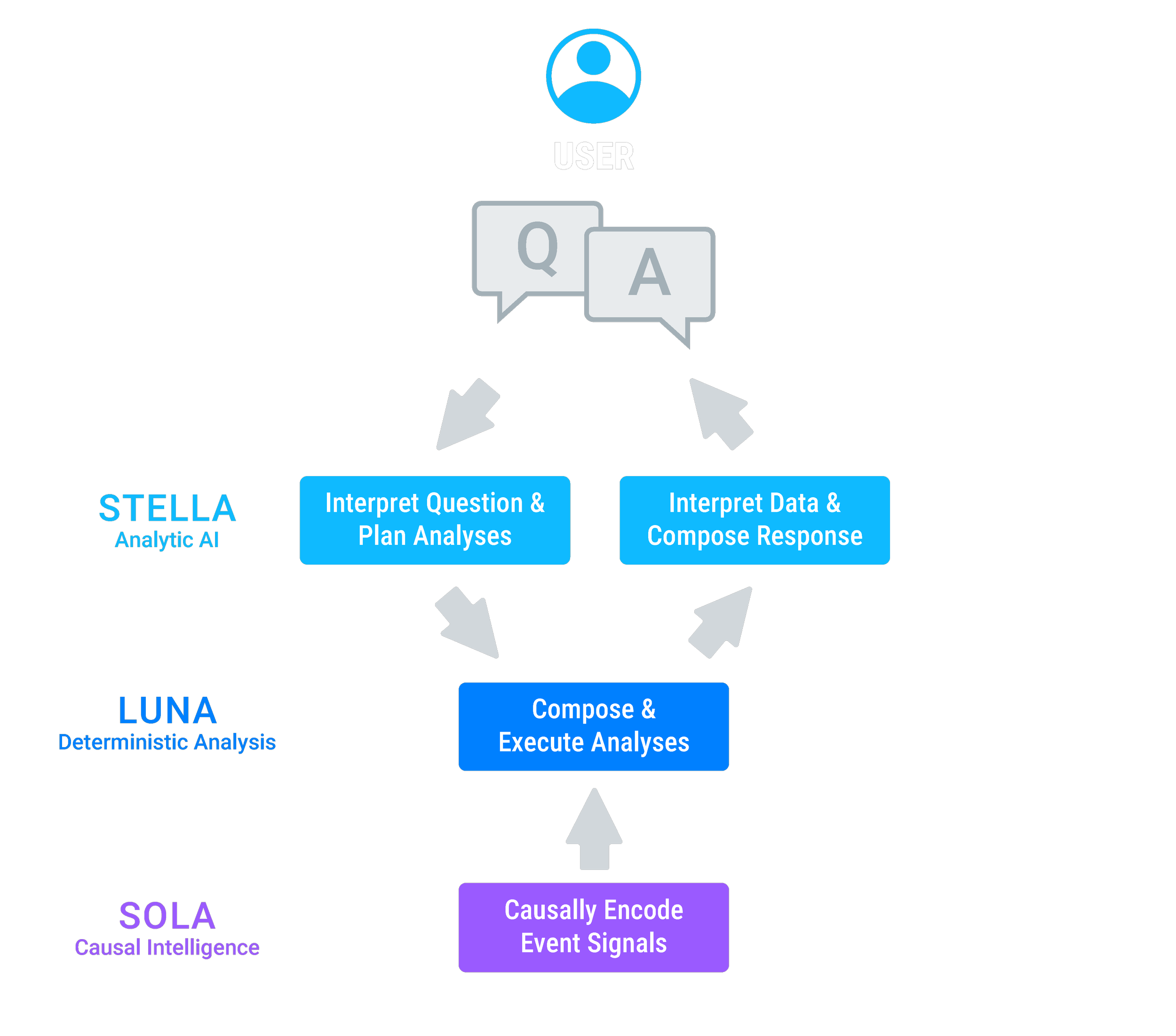
Causal AI is special because it enforces separation of three critical functions. A causal data foundation (Sola) defines an enterprise’s semantic spine and causal structure explicitly — reducing the latitude for AI inference drift. A deterministic workflow engine (Luna) executes every required analysis, so quantitative outputs are always reproducible and auditable end-to-end. The Analytic AI (Stella) translates natural-language questions into structured analytical plans and interprets the quantitative outputs within the context of the ongoing user conversation. Through this architecture, Causal AI delivers rigorous reasoning about cross-functional cause-and-effect while maintaining high trust via numbers that are deterministically repeatable and human auditable.
Practically…
Causal AI is special because it can reason as brilliantly as your best human analysts about what is behind the important outcomes in your business and how you might influence those outcomes. And, it can do so at scale and with immediacy no team of humans can match.
The Longer Answer
The easiest way to understand what makes Causal AI different is to walk through a typical inquiry/response interaction. Let’s do that.
Stella is our AI’s natural language interface. You ask it normal business questions in normal business language, like “What’s going on with our Commercial business in Texas?” Stella interprets your inquiry, identifies the relevant information in Sola’s Causal Intelligence repository, and designs an analytical procedure to retrieve and transform that information to answer the question you asked… as well as the second question that’s usually implied-but-unspoken: …and, why?
Luna executes Stella’s analytical plan, pulling causally-encoded data from Sola.
Specialization = The Right Tool for Each Job
You’re probably wondering why Stella doesn’t do the analytical work itself. The reason is that LLMs are good at many things, but they are not good at doing analytical work in ways that are deterministic, auditable, and human-interpretable. Luna is designed to do analytical work within those three constraints. So, by forcing Stella to work through Luna, we get the best of both worlds: the fluency and suppleness of an LLM, with the rigor and transparency of a deterministic, human-readable analytical workflow.
Stella then interprets the results of the Luna analysis, explaining how those results connect to your question – again, in natural business language. You can continue to refine and extend this conversation as your curiosity and intuition guide you. Then, when you have a package that you believe supports an intervention, you can share that package with a human analytic auditor from your team who will use Luna’s WYSIWYG interface to walk through each step of the workflow and verify that the analysis has been performed in accordance with company standards.
You can also forward that package to your team and your peers to begin the socialization process. When they view that package, they can see full lineage tracing on every metric in every table and visualization, all the way down through Luna’s analytical work and Sola’s causal mapping work – all the way back to enterprise source data. If you choose, they can also see the conversational history between you and Stella that led to the analysis and conclusions, getting everyone on the same page quickly.
The Bottom Line
The cause-and-effect signals encoded into Sola’s Causal Intelligence foundation allow Stella to reason impressively about root causes and consequences, quickly connecting evidence to action. And, the determinism, auditability, and end-to-end lineage tracing of Luna builds organizational trust in Stella’s reasoning.