
What difference does Causal Intelligence make?
Most enterprises operate with partial visibility into the forces that drive performance. Costs fluctuate without clear explanation. Customer behavior creates unexpected operational strain. Commercial actions produce downstream effects that are hard to anticipate. Operating policies improve outcomes in some areas while degrading them in others. Causal Intelligence from Eyeris provides deep insights into the causal mechanisms that drive high-impact decisions.
Causal Cost Functions
Costs are not fixed or linear. They emerge from interacting processes with capacity limits, variability, and cross-functional dependencies. Causal Intelligence reveals the network of cross-functional causes behind every cost, making root drivers visible and revealing how each customer, product, and location contributes to costs.
Causal Customer Behaviors
Each customer creates a distinct value profile through buying patterns, usage, payment behavior, service demands, and churn risk. Causal Intelligence captures these behaviors over time and links them to both commercial triggers and operational consequences.
Operating Policy Causality
Policies that govern efficiency and reliability do not affect all customers or products in the same way. Causal Intelligence quantifies the effects of policy changes across segments, products, channels, and locations.
Commercial Activity Causality
Every commercial initiative drives operational consequences. Promotions, pricing changes, and sales incentives can create volume spikes, product mix shifts, and service strain. Causal Intelligence measures both the revenue impact and the downstream cost effects, revealing where value is created or destroyed.
Explore the impact of Causal Intelligence on key applications by clicking any link in the diagram
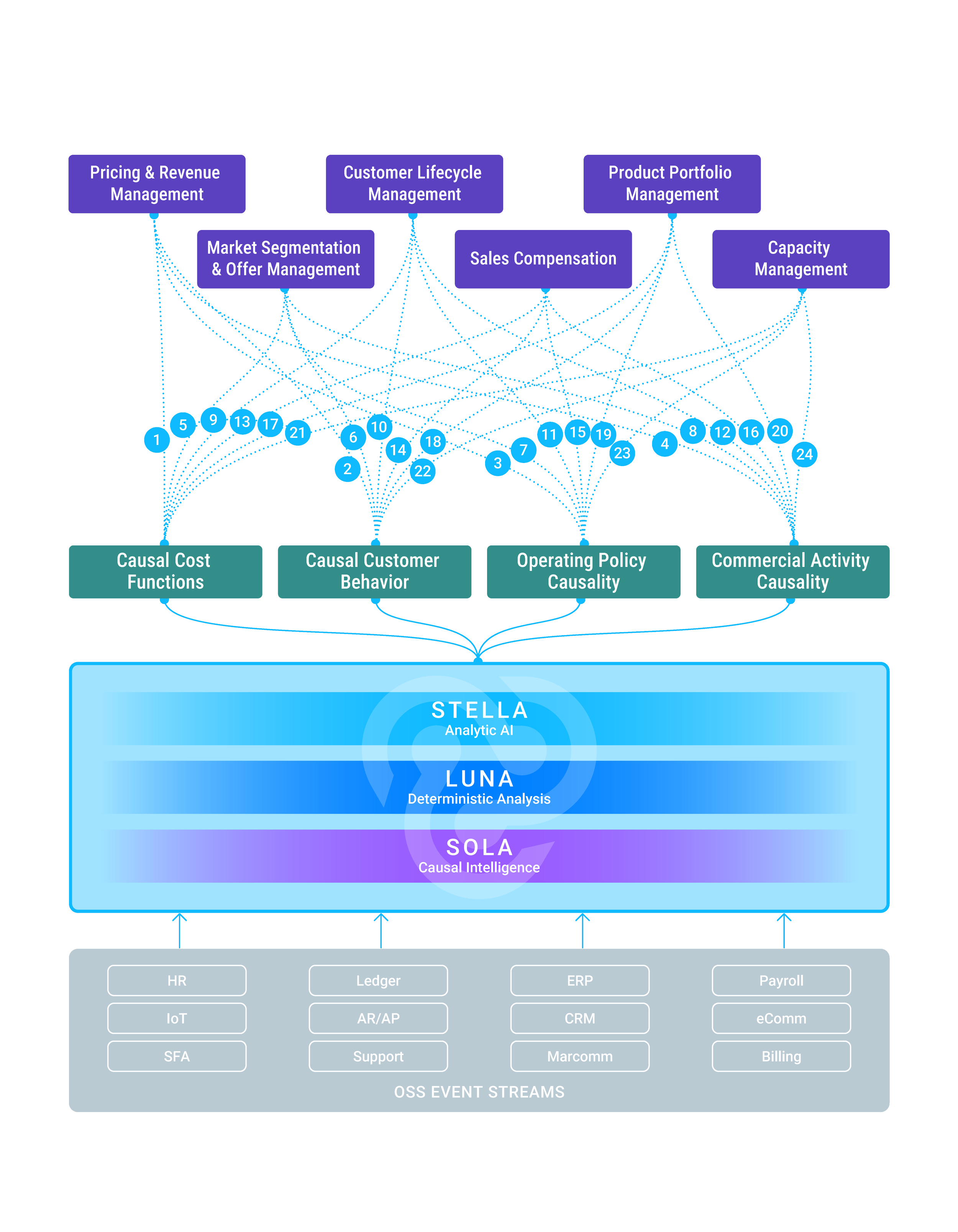
Six High-Impact Applications
Causal Intelligence plugs directly into seven high-impact decision processes, unlocking value by feeding them new insight into those four powerful causal mechanisms above: cost functions, customer behavior, operating policy effects, and commercial activity consequences.
Pricing and Revenue Management
Causal Intelligence refines the feasible pricing zone — the narrow range where price changes do not destroy demand or margin. It quantifies effective customer price elasticity based upon how customers actually change buying behavior when price changes. It also reveals the full incremental cost and capacity effects of demand shifts. Pricing decisions move from revenue optimization to value creation.
Market Segmentation and Offer Management
Causal Intelligence shows how each offer to each segment drives unique operational and financial outcomes. Segmentation is defined by behavior and margin consequences, rather than demographics alone. Investment shifts toward customer-product combinations that create sustained value.
Customer Lifecycle Management
Causal Intelligence tracks how each customer’s behaviors evolve and the financial consequences of those behaviors. Cost-to-serve becomes visible at each stage of the relationship. Lifecycle management shifts from maximizing uptake to shaping behaviors that increase long-term value.
Sales Compensation
Causal Intelligence connects sales activity to enterprise value creation. It shows how individual accounts and deals translate into downstream cost and margin outcomes. Incentives are aligned to value instead of volume, reinforcing behaviors that improve long-term performance.
Product Portfolio Management
Causal Intelligence reveals how different products attract customers whose behaviors differ, creating unique customer-dependent cost functions by product. Product profitability reflects the impact of the customers it attracts, not just a generic gross margin. Portfolio decisions shift toward products that improve enterprise-wide outcomes.
Capacity Management
Causal Intelligence shows where customer behavior, commercial actions, and operating policies are in conflict, creating capacity bottlenecks or underutilization. Capacity can be managed as a coordinated system aligning demand management to operational realities.